
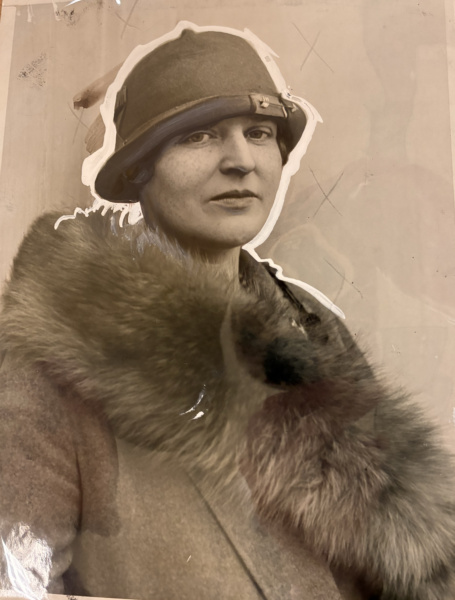
[Germaine Tailleferre]. [ca. 1925]. Barton, Ralph–& Mrs. No. 4–Artist–Was Germaine Tailleferre, File: Biographical. New York World-Telegram and the Sun Newspaper Photograph Collection, Biographical File, A to L, pp021033. Prints & Photographs Division.
Marcelle Germaine Taillefesse (later, Tailleferre (1892 – 1983) was born in a southeastern suburb of Paris and received her earliest musical training from her mother. Like Claude Debussy and Maurice Ravel, Tailleferre studied at the Paris Conservatory, where she focused on composition and befriended several musical colleagues, including Frenchmen Georges Auric, Louis Durey, Darius Milhaud, Francis Poulenc and the Swiss Arthur Honegger. This group became known as Les Six, and as they had all come of age around the time of World War I, they hit their stride after the war had ended. Their first and only album was published in 1920, but different members of the group continued to collaborate to varying degrees for the next several decades.
Their collective style of Les Six was one of neo-classicism, which infused traditions of the past into constructs of the present. As an example, Tailleferre’s Ouverture features a harpsichord, which is typically considered to be an instrument from the Baroque era (ca. 1600 – 1750). In this work, she employs idiosyncratic writing for the instrument that harnesses its historical significance but situates it in a modern framework. The oeuvre of Les Six is often juxtaposed with the styles that were or had already been in vogue in Europe, including the massive operatic works by Richard Wagner and the impressionistic writing of Debussy and Ravel. Tailleferre outlived each of her Les Six colleagues, having moved briefly to the United States in the 1920s, but returning shortly thereafter, and to Philadelphia during World War II. On her return to France, she continued to compose and did so until shortly before her death in 1983. Her compositions include symphonic works, film scores, operas, concertos (traditional and for unique instrumental combinations, sometimes including voice), and chamber music.
Premiered at a 1932 Christmas concert, Germaine Tailleferre’s Ouverture explodes with energy. Scored for pairs of woodwinds (plus piccolo and English horn), full brass and percussion sections, and strings, her work also includes two harps, celesta, and harpsichord. From the very beginning, the opening coup d’archet (stroke of the bow) functions as “call to attention,” which, bolstered by the winds, reveals a bold, robust sound. The middle section of the piece is lighter in texture, but with the return of the three-chord call comes the third and final section. Here, Tailleferre displays her ability to juxtapose instrumental grandiosity with intricate fugal writing. Each of the instrumental groups is discernible, as evidenced by the interplay of upper woodwinds and strings, the strokes of the strings, the brass chords, and melodic passages tossed between and among the instruments. But the composite character of the piece is enhanced noticeably by the idiosyncratic writing for the harps, celeste, harpsichord, and percussion. In particular, the harpsichord showcases the continual motion that is typical for the instrument but seems anachronistic for a twentieth-century work. The percussion battery lends a band-like ambiance to the overture, generating momentum and propelling the piece forward, as in a march.
Composed in 1928, the Harp Concertino employs a standard three-movement structure, but its instrumentation is unique. The solo harp is accompanied by the strings, one piccolo, two flutes, an E-flat clarinet, one trumpet, a pair of horns, and percussion (snare drum and timpani). The first movement (“Allegretto”) opens with a soundscape typical of early twentieth-century French orchestral works: slightly impressionistic with a hard-to-discern tonal center. The pair of flutes soar with the harp as the movement opens, with pizzicato strings maintaining the pulse. The violins and woodwinds initiate a lilting melody-like figure, but the true, ten-note motif makes its first appearance in the trumpet. Intermittently, sounds seem to layer on top of one another, only to be teased apart into discernible entities. The virtuosic writing for the harp culminates in a cadenza—an extended solo passage—which then gives way to the orchestra’s return. With the familiar passages comes nuance, and the movement draws to a close with two distinct iterations of the ten-note motif in the brass.
The second movement “Lent” assumes a different, and less dense, character as the harp’s arpeggios are accompanied by a series of solo melodies in the winds. Only when the arpeggios are replaced by glissandos do the winds move away from singable lines to their own series of complex arpeggios. The movement concludes quietly and unassumingly.
The third movement “Rondo” opens with a harp glissando, followed by an introduction of the melody in the right hand of the harp. The simple harmony, in the strings, follows the expected tonal trajectory. But the predictability does not last for long. Tailleferre infuses unexpected instrumental lines throughout the midsection of this movement, surprising the listener at every turn. The piece concludes with a flourish, punctuated by the taps of a snare drum and single, dramatic chord.
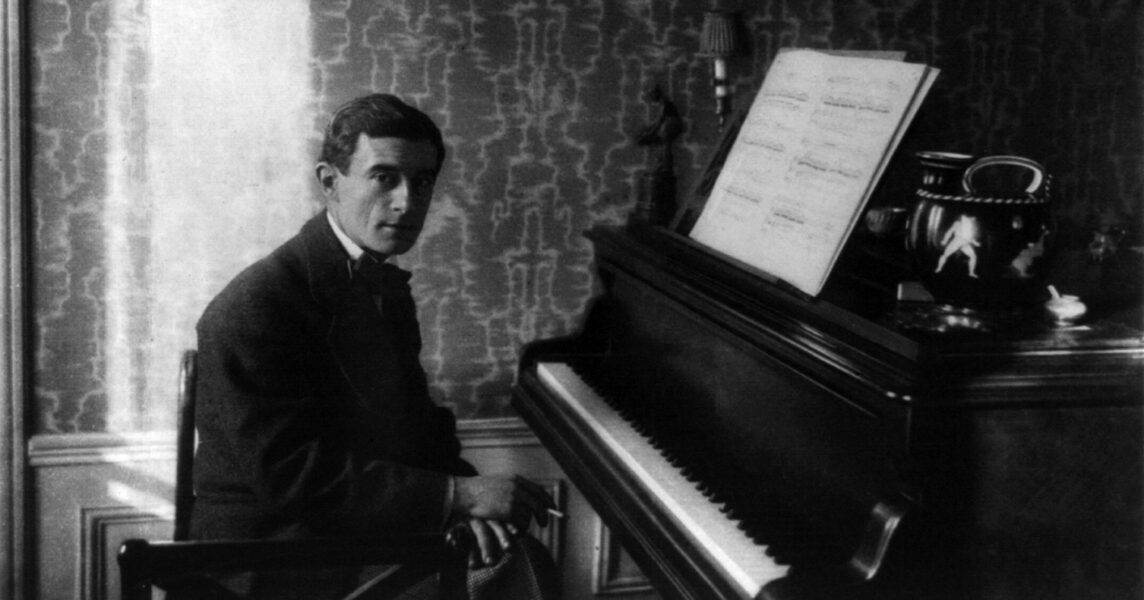
“Maurice Ravel.” Ca. 1915. Photographic print. Library of Congress Prints and Photographs Division. LC-USZ61-232.
Maurice Ravel (1875 – 1937) was born in the southwest of France, near its border with Spain, but his family relocated to Paris shortly thereafter, where he received his musical training. By the time he entered the Paris Conservatory in 1889, he had already been exposed to music from around the world, as he had attended the 1889 Paris Exposition earlier that year (as had Claude Debussy). As a student, Ravel pursued piano lessons, but he eventually turned his attention to composition.
His compositional output spanned multiple genres—from chamber works to symphonic works and operas, and he experimented with novel ideas. For example, he composed a concerto for piano in which the performer only uses the left hand. In one of his most famous works, Bolero, Ravel featured a sequence of individual soloists, whose melodies overlaid a consistent repetitive rhythmic accompaniment in the strings and percussion. Over the course of this lengthy piece, the sound grows and grows, ultimately transformed, yet strikingly similar, to its modest beginning. In other words, Ravel was capable of taking and capitalizing on musical risks, by which he explored techniques that had not yet been in the purview of classical music. He regularly sketched music ideas for solo piano or piano (four hands) and then orchestrated the work for instrumental ensemble, thereby expanding the work’s tonal palette. Such is the case with Mother Goose.
Like his contemporaries, Ravel was exposed to the vicissitudes of life in the early part of the twentieth century. He fought in, and was severely affected by, the first World War. However, the contemporaneous advents in sound recording technology enabled him to achieve a reach far beyond that which had been possible for his musical predecessors. He remained active until suffering from an illness, which led to his death in 1937.
Ravel conceived his suite titled Mother Goose (Ma Mère l’Oye) in 1908 as a piano duet suitable for children, as evidenced by the designation printed on the score “5 pièces enfantines pour PIANO à 4 mains” (five children’s pieces for piano four hands ). Indeed, the piece was dedicated to two young performers and then premiered in 1910 by two others; the following year, Ravel orchestrated the work.
The resultant piece is scored for 2 flutes (1 doubling on piccolo) , 2 oboes (1 doubling on English horn), 2 clarinets, 2 bassoons (1 doubling on contrabassoon), 2 horns, percussion, celeste, harp, and strings. The title of each of the five movements reveals the fairy tale to which Ravel refers.
Of these five tales, the first two (“Sleeping Beauty” and “Hop-o’-My-Thumb”) were the work of Charles Perrault and published in his 1697 anthology Histoires ou contes du temps passé, avec des moralités: Les Contes de ma Mère l’Oye (Tales or Stories of the Past with Morals: Tales of Mother Goose). Today’s readers may already be familiar with several of the tales in Perrault’s collection, especially “Little Red Riding Hood” and “Cinderella.” The latter of these, alongside “Bluebeard” will be well-known to opera fans, as several composers have brought these stories to life on the stage, including Gioachino Rossini (La Cenerentola, ossia La bontà in trionfo [Cinderella, or Goodness Triumphant]), Jules Massenet (Cendrillon [Cinderella]) and Béla Bartók (A kékszakállú herceg vára [Bluebeard’s Castle]).”
The third and fourth tales in Ravel’s suite were inspired from the tales in two other sources. “Laideronnette, Impératrice des Pagodes” is based on the tale “Le Serpentin Vert” (“The Green Serpent”) published by Marie Catherine d’Aulnoy, whose 1698 anthology Contes Nouveaux ou Les Fées à la Mode, (New Tales, or Fairies in Fashion) appeared one year after Perrault’s anthology.
“Les entretiens de la Belle et de la Bête” comes from the story of “Beauty and the Beast,” which was originally written by Gabrielle-Suzanne Barbot de Villeneuve, who had been inspired by Perrault and d’Aulnoy. Her work, which appeared in print in 1740, was adapted by Marie Leprince de Beaumont and published in Le Magasin des enfants in 1756.
The fifth movement has left listeners wondering about its precise source, but many critics agree that “Le Jardin féerique” is part of the “Sleeping Beauty” story.
In the score, the three inner movements are accompanied by quotations from their respective stories, each of which guides the listener’s sonic journey.
Il croyait trouver aisément son chemin par le moyen de son pain qu’il avait sеmé partout ou il avait passé; mais il fut bien surpris lorsqu’il n’en put retrouver une seule miette: les oiseaux étaient venus qui avaient tout mangé. (Ch. Perrault.)
He believed he would easily find his way because of the bread that he had spread everywhere he had been; but he was very surprised to find not a single crumb: the birds had come and eaten everything.
Elle se déshabilla et se mit dans le bain. Aussitôt pagodes et pagodines se mirent chanter et à jouer des instruments: tels avaient des théorbes faits d’une coquille de noix; tels avaient des violes faites d’une coquille d’amande; car il fallait bien proportionner les instruments à leur taille. (Mme d’Aulnoy: Serpentin Vert)
She undressed and got into the bath. Immediately, the pagodas and their attendants began to sing and play instruments: some had theorbos made from a nutshell; others had viols made from an almond shell; for the instruments had to be proportionate to their size.
“Quand je pense à votre bon cœur, vous ne me paraissez pas si laid.”
“Oh! dame oui! j’ai le cœur bon, mais je suis un monstre.”
“Il y a bien des hommes qui sont plus monstres que vous.”
“Si j’avais de l’esprit, je vous ferais un grand compliment pour vous remercier, mais je ne suis qu’une bête.”
“La Belle, voulez-vous être ma femme? ”
“Non, la Bête! ”
“Je meurs content puisque j’ai le plaisir de vous revoir encore une fois. ”
“Non, ma chère Bête, vous ne mourrez pas: vous vivrez pour devenir moп éроux! ”
… La Bête avait disparu et elle ne vit plus à ses pieds qu’un prince plus beau que l’Amour qui la remerciait d’avoir fini son enchantement. (Mme Leprince de Beaumont)
When I think of your kind heart, you don’t seem so ugly to me.
Oh! Yes, indeed! I have a kind heart, but I am a monster.
— There are many men are more monstrous than you.
— If I had any wit, I would pay you a great compliment to thank you, but I am only a beast. […]
Beauty, will you be my wife? —
No, Beast! […] —
I die content since I have the pleasure of seeing you once more. —
No, my dear Beast, you will not die: you will live to become my husband! —
… The Beast had disappeared, and at her feet she saw only a prince more handsome than Love, who thanked her for breaking his enchantment.
Listening clues for Mother Goose
In this movement, listen for the ways in which the orchestra depicts a dreamlike state. Consider the extent to which Ravel evokes the techniques associated with “impressionism.”
In the original story, the protagonist is a very small character who embarks on all sorts of adventures. Listen for any rhythms that indicate his whimsical movements along the path on which he had placed the breadcrumbs. Note also the lightness of the writing to correspond with the character’s stature.
In this movement, Ravel evokes the Eastern world by infusing his writing with exotic musical idioms.
The conversation in this movement is evidenced clearly by the contrasting styles assigned to each character. The music for the Beauty is lyrical and harmonically pleasing whereas the music for the Beast is more dissonant.
The final movement is a sonic montage, showcasing Ravel’s talent at its finest as he weaves the tales together in this grand finale.
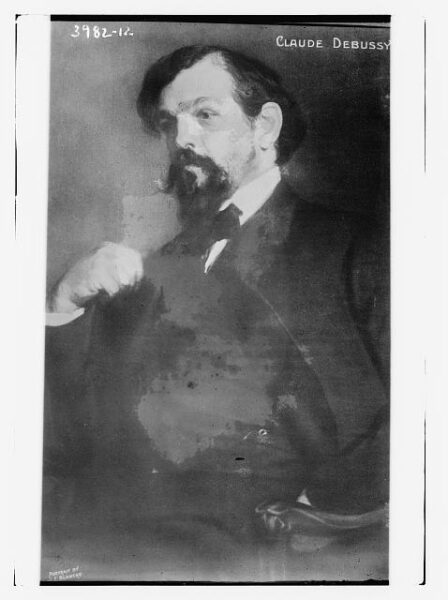
Bain News Service, publisher. “Claude Debussy.” [between ca. 1915 and ca. 1920]. Negative: Glass. George Grantham Bain Collection, Library of Congress Prints and Photographs Division. LC-DIG-ggbain-22832.
Achille-Claude Debussy (1862 – 1918) was born in St. Germain-en-Laye, which is in the north-central region of France. His early training on the piano provided stability and focus to an otherwise unsettled childhood, and he was accepted to the Paris Conservatory at the age of ten. He resumed his studies, but poor performance on Conservatory examinations thwarted his dream of becoming a piano virtuoso. Thus, he channeled his energies into composition and, in so doing, embraced a new style of writing that eschewed the large-scale, dramatic flair of Romanticism. Debussy sought to evoke moods and landscapes through innovative harmonies and tone colors, a style that became known as “impressionism.” His interest in liturgical modes fostered his experimentation with different scales, and he often looked to other cultures for sources of new musical material and techniques, especially east Asia and Spain. In 1884, Debussy was awarded the coveted Prix de Rome for his cantata for vocal trio and orchestra, L’enfant prodigue.
Over the course of his career, Debussy composed pieces in a variety of genres for different ensemble configurations—ranging from piano solos to pieces for full orchestra. His two-movement work for harp and string orchestra, Danse sacrée and Danse profane, was premiered in 1904, but other versions, featuring different instruments, have been published and performed.
This version is scored for string orchestra and harp, and it exemplifies “impressionistic” writing, even though Debussy resisted that term. Here, a discernible melody is replaced by a hazy movement of sound over time. The harmony is discernible, but unpredictable, as Debussy explores different progressions that employ chromaticism. The result is a musical scene painted by tones.
National Philharmonic relies on the generosity of its donors to continue bringing you the music. Your contribution is critical to our continued success.