
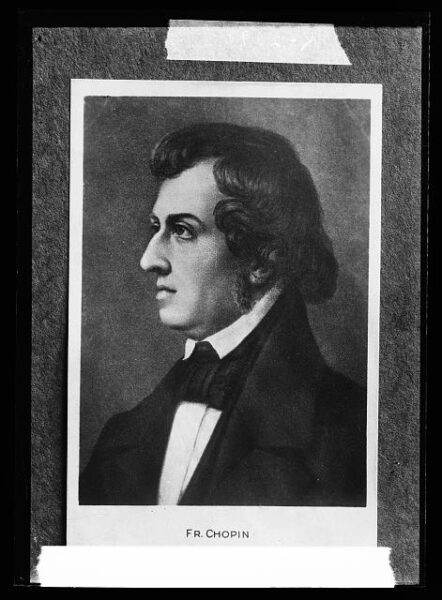
“F. R. Chopin.” Detroit Publishing Company [between 1915 and 1925]. Negative: glass. Detroit Publishing Company photograph collection, Library of Congress Prints and Photographs Division. (LC-DIG-det-4a27873)
Over the course of his career, Chopin wrote almost exclusively for piano, but his compositional output encompassed a range of genres and styles, which, for the purposes of tonight’s concert, can be divided loosely into five categories:
For this final concert in the Extreme Chopin series, pianist Brian Ganz is performing works from the second half of the composer’s life. Each of these categories is represented, and although the selections differ widely in character, they complement each other when bundled together.
The annotations below highlight a few of Ganz’s selections, but to learn more about each of the pieces on his program, be sure to visit the American Folklife Center table before the concert and during intermission.
One piece—the Waltz in A minor, Op. Posth.—deserves particular attention. Although the term “waltz” may be very familiar to listeners, it is highly unlikely that audience members have had the opportunity to hear this piece live until this evening. For nearly 200 years, the work was unknown. Then, in October 2024, the manuscript score was discovered by Robinson McClellan, a curator at The Morgan Library & Museum in New York City. Such discoveries are very rare in the classical musical world, and, when the waltz was added to Chopin’s oeuvre, it became the subject of international intrigue. The New York Times announced and documented the momentous occasion.
As a dance, the waltz developed from the ländler, a folk dance that gained popularity during the later Renaissance Era in what is now southern Germany, Austria, and Switzerland. Both are couples dances in triple meter. The ländler is typically slower and its individual steps are less delicate than those of the ballroom waltz.
Listen for the steady pulse in Ludwig André’s “Ländler Idylle,” available through the Library of Congress’s National Jukebox.
During the Romantic Era, however, the waltz became known as a musical form, which was popularized through the solo piano works of Franz Schubert, Frédéric Chopin, Johannes Brahms. Chopin composed approximately two dozen waltzes, each with its characteristic emphasis on the first beat of three. The manuscript score of Waltz in A minor, Op. Posth. is only a little larger than a postcard; with twenty-four measures, a performance is a mere one minute in duration. Even so, the piece manages to convey the depth of emotion typical of his much more expansive works.
With this nuanced understanding of the piano and its capacity for lyricism, Chopin was able to transform melodic lines originally conceived for the human voice into virtuosic showpieces. For example, the barcarolle [Italian: “barca” means boat, “rollo” means rower] is a song rendered by the boatmen of Venice, who guide the long, narrow gondolas along the city’s canals. As Chopin’s Barcarolle Op. 60 progresses, so, too, does the character of the water portrayed. The opening conveys a sense of tranquility, as would be expected in such a piece, but in this setting, the water becomes more forceful, rising and falling tempestuously. The berceuse is a French lullaby—a song typically sung to lull a child to sleep. The National Jukebox has several recordings of berceuses, including two of Chopin’s Berceuse, Op. 57. As you listen to them (and to Ganz’s live rendering), consider how each one evokes a sense of calm—with and without words. For Berceuse, Op. 57, pay particular attention to the harmony, which is created one note at a time in a series of broken chords. Keen discernment will reveal that the left hand, with only one exception, starts each ascent on a D-flat, emulating a cradle rocking to and fro with measured predictability.
This berceuse and a few other examples notwithstanding, Chopin’s music is not generally considered “programmatic”—that is, his works do not tend to portray explicitly a specific non-musical concept or person. He was known, however, to incorporate popular Polish dance rhythms or tunes in his pieces, thereby evoking a strong sense of Polish nationalism within his music.
For example, throughout Chopin’s catalog of works, there are references to each of the five national dances of Poland—mazur, kujawiak, krakowiak, oberek, and polonaise, yet it should be noted that none of these pieces was ever intended to accompany dancing.
In tonight’s concert, Ganz is performing seven mazurkas: three from Opus 63 and four from Opus 67. The mazurka refers to the mazur, a folk dance in triple meter, whose dotted rhythm (on the first beat) and accent (on the third of three beats) differentiates it from the waltz, whose emphasis falls on the first beat of three. The term derives from the historical region of Mazovia in which Chopin’s birthplace Żelazowa Wola was located.

The Library of Congress’s National Jukebox has recordings of mazurkas. One of the mazurkas on tonight’s program—Mazurka in C-sharp minor, Op. 63, No. 3—has been deemed a kujawiak by twentieth-century musicologists, who point to the minor key and slow tempo as indicators of the distinction between the kajuwiak and mazur (dance) / mazurka (form). Like the mazurka, the kujawiak is also in triple meter, and its name derives from the rural area in central Polish known as Kujawy. However, more recent musicological research (especially that of Halina Goldberg) has called such distinction as anachronistic, because during Chopin’s time, no such distinction existed.
Listen to this recording of Sergei Rachmaninoff performing Mazurka in C-sharp minor, Op. 63, No. 3. To learn more about Rachmaninoff, whose piano concertos were featured by National Philharmonic in September 2024, visit the program notes for the Rachmaninoff Festival concert.
For more information about the krakowiak, the oberek, and the polonaise, visit the program notes from An Evening of Chopin with Brian Ganz.
National Philharmonic relies on the generosity of its donors to continue bringing you the music. Your contribution is critical to our continued success.